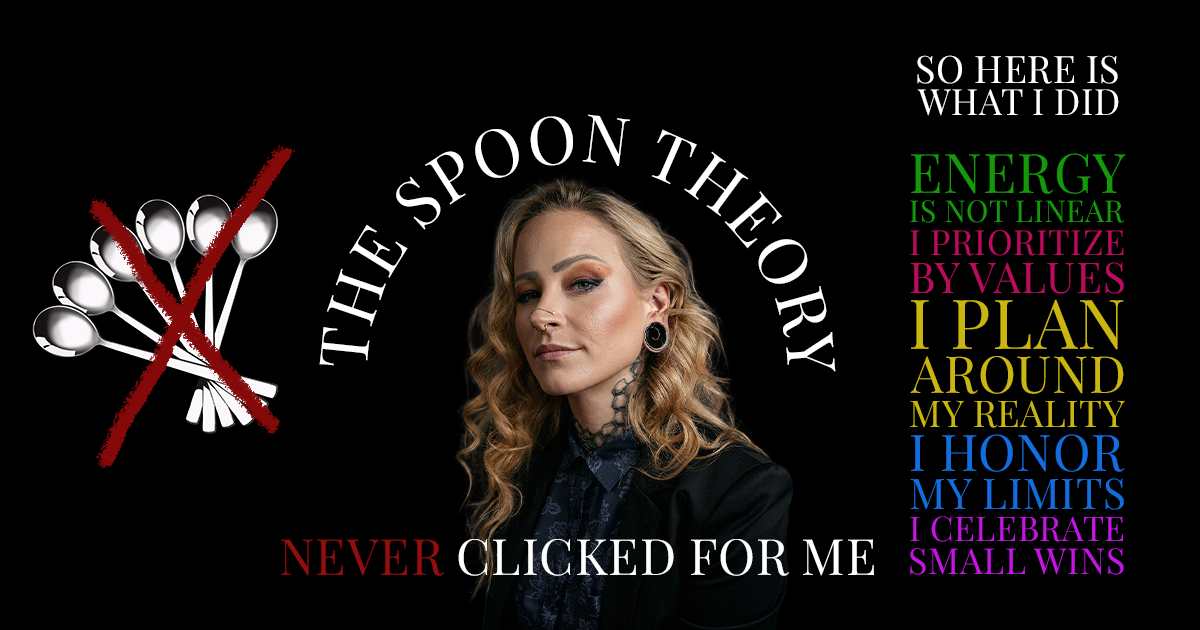
If you have spent any time in chronic illness spaces online, you have heard of spoon theory. Christine Miserandino wrote it years ago to explain to a friend what it is like living with lupus. You start the day with a set number of spoons. Every task costs spoons. Shower, spoon. Get dressed, spoon. Drive somewhere, spoon. Once you run out, you are out, and the rest of the day has to happen on nothing.
It became this whole identity. People call themselves spoonies. There are spoon emojis in bios. It clearly helped a lot of people explain something that is genuinely hard to explain to someone who has never lived it.
It never clicked for me.
I think part of it is because my body does not run out the way a battery runs out. EDS and POTS and MCAS do not deduct evenly. Some days I have a full tank and by 2pm I am face down. Some days I wake up already running on fumes and somehow push through twelve hours. Spoons made it sound predictable. My body is not predictable. My body is chaos with a side of inflammation.
So I needed something else. Here is what actually made sense to me, and maybe it will make sense to you too if spoon theory never quite landed.
I think of my body like a phone with a dying battery and bad software.
Stay with me on this one.
A phone with a dying battery does not just slowly drain at a steady rate. It drains fine for a while, then suddenly drops 20 percent in five minutes for no reason you can figure out. Sometimes it dies at 30 percent. Sometimes it somehow survives at 3 percent for two hours. You cannot trust the percentage. You just have to watch the actual behavior.
That is my body. The percentage on a given day means nothing. What matters is what is actually happening right now. Is my heart rate climbing for no reason. Are my joints clicking more than usual. Is my brain fog thicker than normal. Those are the real signals, not some abstract number I assigned myself at 7am.
And the bad software part. A phone with bad software will randomly restart, freeze, or run a background process that drains everything without you knowing why. That is what a flare feels like. You did not do anything different. You did not use more spoons than usual. Something just decided to run in the background and now you are nonfunctional and you do not get an explanation.
I used to get so angry trying to figure out why a day went bad. I would mentally retrace every step looking for the mistake. Did I sit wrong. Did I eat the wrong thing. Did I stand too long. Sometimes there is an answer. A lot of the time there is not. Sometimes the bad software just runs and you do not get a reason.
Once I stopped needing a reason for every flare, things actually got easier. Not because the flares stopped. They did not. But I stopped wasting energy trying to solve an unsolvable equation every single day.
Here is the other thing nobody tells you about chronic illness and energy management. You do not get better at predicting your body. You get better at reacting to it.
I used to think if I just learned my patterns well enough I would be able to plan around them. Plan my week, know which days to push and which days to rest, basically become the algorithm of my own body. That is not how it actually works. What happens instead is you get faster at recognizing the early signs and faster at adjusting once they show up.
That is a completely different skill than prediction. Prediction is trying to know the future. Reaction is responding well to the present. I am much better at the second one now and I have given up almost entirely on the first one.
If you are newly diagnosed and you are still trying to crack the code of your own body, I want to tell you gently that there might not be a code. There might just be a body that does what it does, and your job is not to outsmart it but to get faster and kinder in how you respond to it.
Some practical things that came out of giving up on prediction and focusing on reaction.
I stopped scheduling things back to back. Not because I know in advance that the day will be bad, but because if it does go bad, I want buffer room instead of a domino effect of cancelled plans and guilt.
I stopped explaining every cancellation with a reason. For a long time I felt like I owed people a justification. My joints were unstable. My heart rate would not come down. I do not always know why and I have stopped pretending I do. Now I just say I am having a flare and I leave it there.
I built a really low bar for what counts as a good day. A good day used to mean I got through my to do list. Now a good day means I did not make things worse. That sounds small but it completely changed how often I feel like I am succeeding instead of failing.
I pay more attention to the early signals than the late ones. By the time I am in full flare mode it is too late to prevent anything. But there are usually small tells fifteen or twenty minutes before things go downhill. A weird heart flutter. A joint that feels off. A wave of nausea that does not match anything I ate. I used to ignore those because they were minor. Now I treat them as information and adjust immediately instead of waiting to see if it gets worse.
None of this means I have it figured out. I still have bad days. I still get blindsided. I still occasionally retrace my steps looking for a reason that probably does not exist. Old habits do not disappear just because you understand them better.
But I no longer feel like I am failing a system I am supposed to understand. I am just a person with a complicated body, doing the best I can with the information I have in the moment. Some days that is enough. Some days it is not. Both of those are okay.
If spoon theory works for you, that is genuinely great and I am not knocking it. It has helped a lot of people communicate something that is hard to put into words. But if it never quite fit your experience, you are not broken and you are not missing something everyone else gets. Different bodies need different metaphors. Find the one that actually describes your reality, even if it is a dying phone with bad software instead of a limited number of spoons.
That is the whole point of all of this anyway. Every body is different. The metaphor that helps you make sense of your life does not have to match anyone else's.